
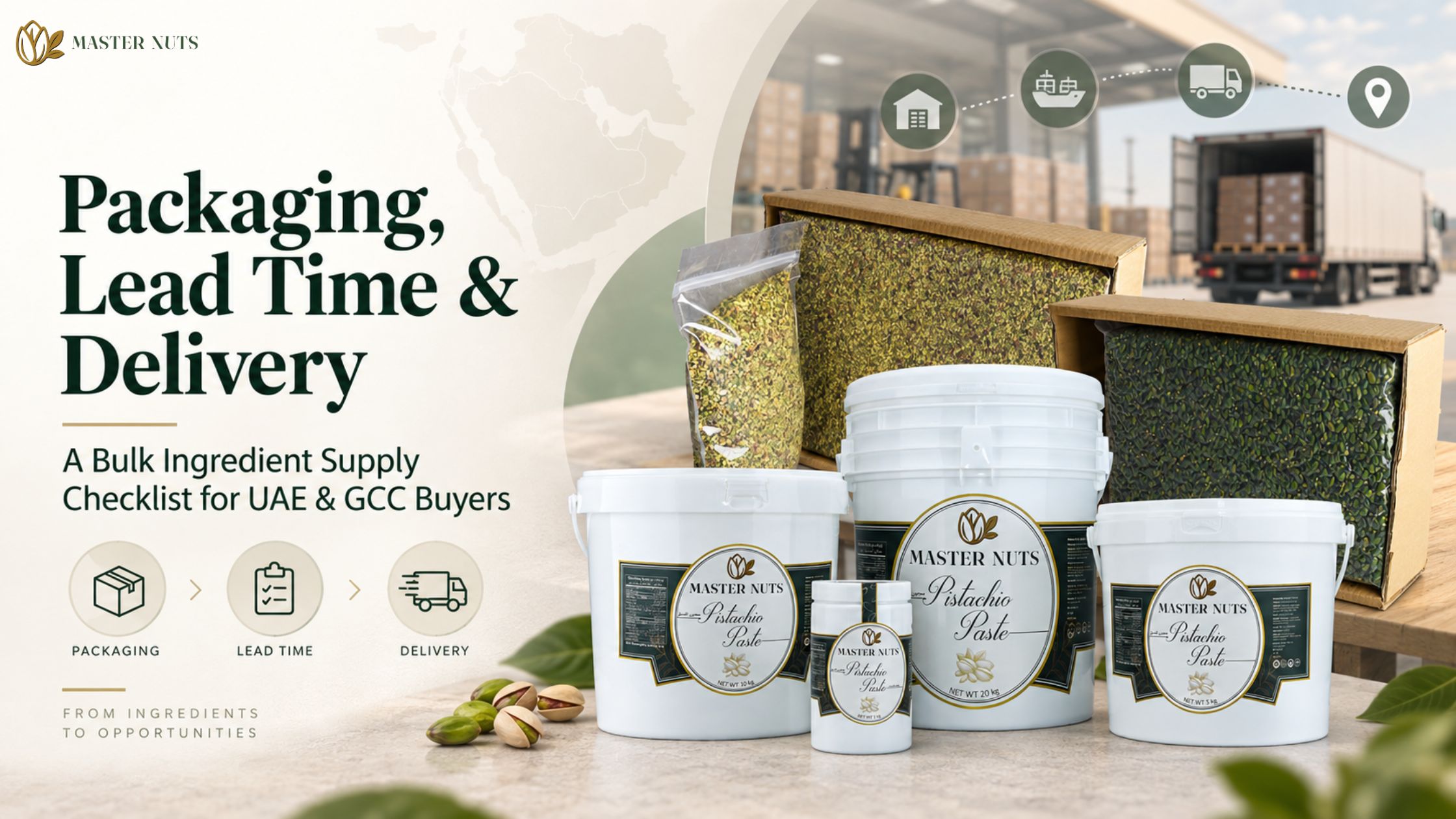
A food ingredient order can leave the supplier on time and still reach production too late. The usual gap sits between three separate decisions: how the ingredient will be packed, when it will be ready for dispatch and who manages each stage of delivery.
UAE and GCC buyers should settle those points before issuing a purchase order. The result is a supply plan that warehouse staff can receive and production teams can use.
Define the product and pack together
Packaging needs to protect the actual ingredient through storage and transport. A dense nut paste, a vacuum-packed kernel and dried rose petals place different demands on the container.
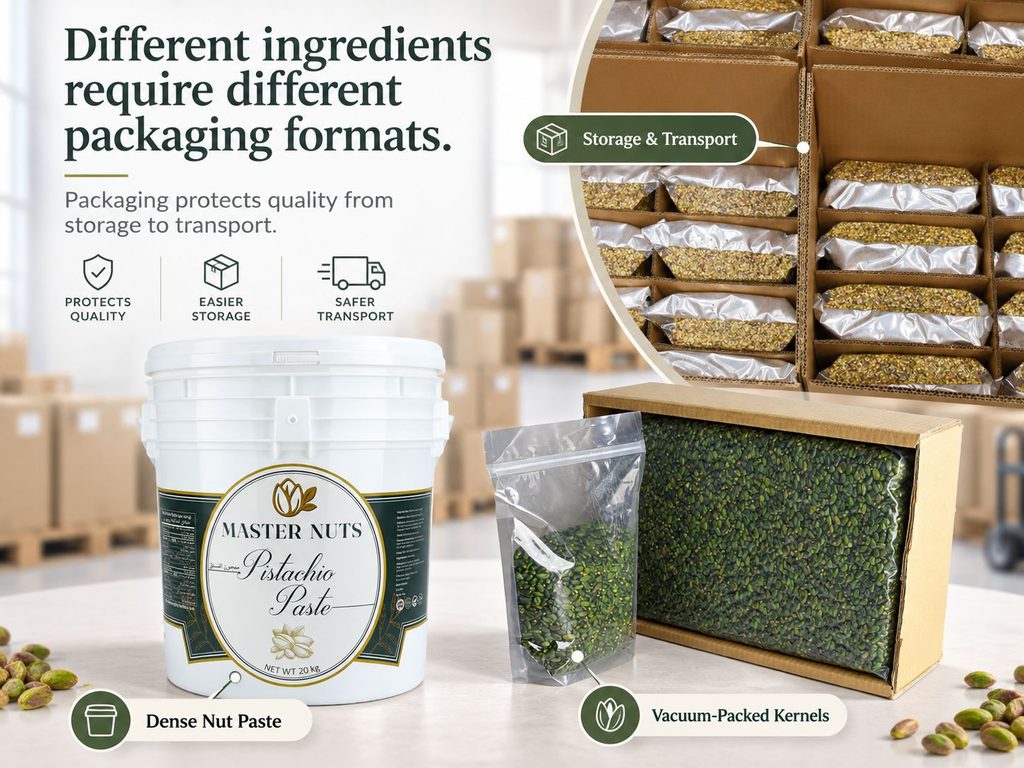
Ask for the complete pack description:
- Net weight per sale unit
- Inner food-contact layer and closure
- Outer carton, pail, drum or other transport pack
- Units per carton and cartons per pallet
- Pallet dimensions, gross weight and stacking arrangement
- Lot and date information printed on each level
- Storage conditions before and after opening
Check how the pack fits your operation. A larger container can reduce packaging cost and handling per kilogram, yet it may create more opened stock or exceed a safe manual lift. A smaller pack may match batch consumption and reduce residue. The right choice comes from warehouse space, batch size, dispensing method and usage rate.
Master Nuts lists product-specific packaging on several public pages. Use those details as a starting point and confirm the exact pack for the item in the quotation, especially when custom packing has been discussed.
Inspect the label before commercial approval
Request a sample label or artwork when label content matters to receiving or market compliance. The product name, grade, lot code and net weight should match the purchase description. Check the declared ingredients, allergen statement, origin information and date format required by your business and destination.
Warehouse staff need a readable lot code on the sale unit. A code placed only on the pallet can disappear when cartons are split across locations.
Add the approved label version to the purchase record. If a language, importer detail or customer-specific label is required, agree on responsibility and approval timing before production begins.
Split lead time into real stages
“Lead time” can refer to several clocks. Ask the supplier to separate them.
| Stage | Question for the quotation | Planning risk |
| Order approval | Which event starts the schedule? | Artwork, deposit or specification approval may still be open |
| Production | When will the goods be ready? | Raw material, processing and packing time can vary by product and volume |
| Pre-dispatch | Which documents or inspections are required? | Missing approvals can hold ready stock |
| Transport | What is the planned mode and transit window? | Road, air and sea routes carry different timing and capacity risks |
| Border and local clearance | Who supplies documents and manages entry? | Document errors or inspections can delay release |
| Final delivery | When and where will the carrier hand over the goods? | Site access and appointment rules can add time |
Record a confirmed ready date and an estimated arrival date. They answer different questions. Production planning should also know whether the promise applies to in-stock material or an order that requires new production.
Add a buffer based on the ingredient’s importance and route history. A critical input with no approved substitute deserves a different stock policy from a garnish used in one seasonal line.
State the delivery responsibility in writing
The quotation should identify who books freight, pays each cost, prepares export documents, handles clearance and carries risk at each stage. Use the agreed Incoterm with its named place and version where international trade terms apply.
Avoid shorthand such as “delivered GCC” without a destination and responsibility split. Delivery to a border, port, city warehouse or factory door creates different costs and tasks.
For road freight within the GCC, confirm the pickup location, final address, vehicle requirement, border route and expected customs process with the logistics provider. For UAE delivery, check the emirate, delivery window and any access restrictions at the receiving site.
Ask how delays and damage will be communicated. Procurement needs the contact for shipment updates, while warehouse staff need the carrier and vehicle details required for site access.
Build the document pack around the route
Commercial invoice and packing list details should match the product and shipment. Depending on the destination and transaction, buyers may also require origin, health, conformity, test or import documents.
List each required document, its issuer, required format and due date. Then confirm who reviews it before dispatch. Destination rules and customer requirements can change, so the importer or appointed clearance specialist should approve the route-specific pack.
Keep quality documents connected to the shipment. A COA should identify the lot being delivered, and the product specification should match the item approved by the buyer. The separate COA and product specifications guide explains that review.
Plan transport conditions for the ingredient
Use the product’s approved storage conditions to set the transport brief. Confirm whether the shipment needs temperature control, protection from humidity, odour separation or limits on stacking and sunlight exposure.
Nut ingredients can pick up foreign odours or suffer when packs are punctured and exposed. Dried petals need protection from moisture and crushing. Put handling instructions on the documents used by the warehouse and carrier.
For long routes, ask how the supplier prepares pallets and secures the load. Agree on any data logger, seal or inspection requirement before dispatch. If temperature evidence is part of acceptance, define the review process and the action for an excursion.
Prepare the receiving site
The delivery appointment should reach the warehouse team before the vehicle does. Share the purchase order, product list, expected lot details, pallet count and any special handling instruction.
At receipt, staff can check:
- Vehicle and seal condition where applicable
- Pallet and carton count
- Outer damage, water marks or contamination
- Pack seals and vacuum condition where relevant
- Product, lot and date details
- Required shipment and quality documents
- Recorded transport condition when specified
Define the release status. Goods may move to quarantine while documents or samples are reviewed. Storage space should already meet the ingredient requirements during that hold.
Photograph damage before unloading is complete and record it on the carrier document. Fast evidence helps purchasing and logistics teams handle a claim without relying on memory.
Use a reorder point that includes uncertainty
Inventory planning should cover average demand, replenishment time and variation in both. Use actual consumption rather than quotation volume. Include production lead time, transport, clearance, receiving and quality-release time.
Seasonal peaks and promotions can move the order date earlier. So can public holidays, factory closures and route congestion. Review the plan with the supplier when forecasts change materially.
Put the checklist into the purchase order
A final supply record should name the product code, approved specification, pack, quantity, label, ready date, delivery term, destination, transport condition and required documents. Add the contact for updates and the process for approving a change.
Use the Master Nuts contact form or WhatsApp to send the product, required quantity, preferred packaging and delivery destination. Ask for an order-specific quotation that separates production lead time from transport and confirms the delivery scope.




Leave a Reply