
A pistachio sample can pass a sensory review and still create problems when the commercial shipment arrives. The paperwork often shows the first warning. A product name may be too broad, the lot on the cartons may differ from the certificate, or a reported result may lack the unit needed for comparison.
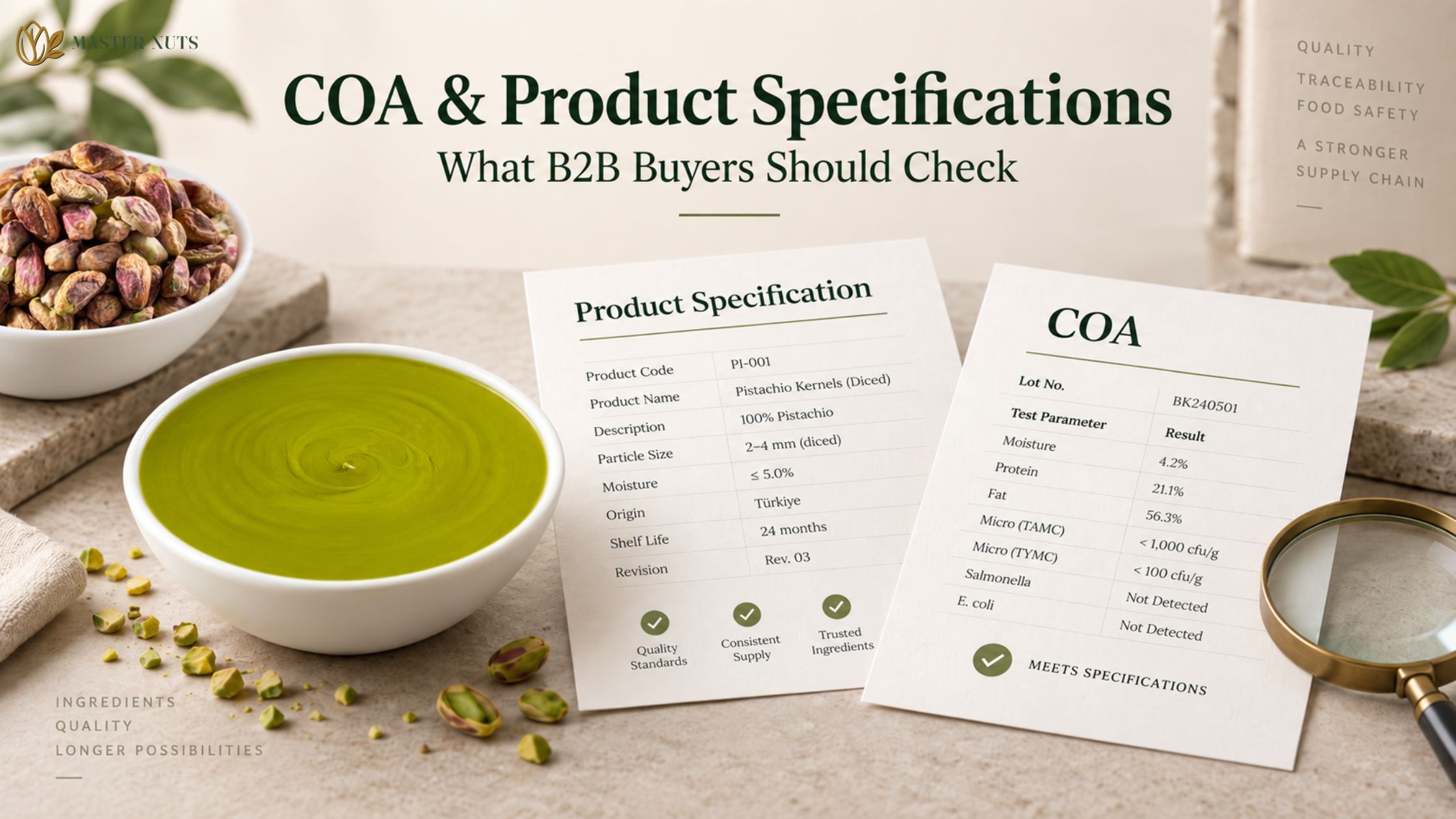
Procurement, quality and food-safety teams need two separate documents. The product specification describes the ingredient offered for sale and the agreed acceptance points. A Certificate of Analysis, usually shortened to COA, reports selected information for a particular lot.
Reading them together gives the buyer a usable answer: does this shipment match the product that was approved?
The specification and COA have different jobs
A product specification is the standing description of the ingredient. It may cover identity, composition, physical properties, microbiological criteria, packaging, storage and shelf life. Some lines are firm limits. Others describe a typical result or an expected appearance.
A COA belongs to a batch or lot. It should identify the material and show the results, limits or conformity statements reported for that lot. Its value depends on a clear link to the product specification and the shipment.
| Document | Main purpose | Buyer check |
| Product specification | Defines the offered ingredient and acceptance criteria | Confirm product code, revision, units and which values are binding |
| COA | Reports lot-specific results or conformity | Match product identity and lot number to the delivered goods |
| Packaging label | Identifies the physical material received | Reconcile the name, code, lot and net weight with the order |
| Purchase order | Records the commercial requirement | Use the same product description and document revision agreed during approval |
Ambiguous terms deserve attention before the first order. “Typical” gives a different commitment from “maximum,” “minimum” or a stated range. Ask the supplier which fields control release and which ones describe normal variation.
Start with identity and revision control
Compare the product name, grade, format and product code across the quotation, specification, COA and label. “Pistachio kernels” leaves too much room when the approved item is a peeled green grade, a regular skin-on kernel or a particular diced cut.
Processed ingredients need the same precision. For pistachio paste, confirm the grade and ingredient declaration. For cuts, record the kernel type and size description. If the material has been roasted or otherwise treated, place that information in the approved product identity.
Then check the specification revision and issue date. A familiar filename can contain an outdated composition, pack format or test schedule. Save the approved version with its revision reference and require advance notice when a change affects the product your team has qualified.
Read results with limits units and methods
A COA number becomes useful when the reader can see what was measured, in which unit and against which criterion. Moisture reported as a percentage needs a percentage limit. A microbiological result needs its organism, sampling basis and reporting unit. Particle size needs a defined test or screening description.
Place each COA result beside the matching specification line. Check these details:
- Test or characteristic name
- Result and unit
- Acceptance range or limit
- Method reference where method choice affects interpretation
- Conformity status
- Test date or certificate date
Qualifiers carry meaning. “Not detected,” “below the reporting limit” and “conforms” describe different kinds of information. When a numerical result is required by your quality system, request it during supplier approval rather than after a shipment is waiting in quarantine.
The test schedule also matters. Some characteristics may be checked on every lot, while others are verified periodically through a monitoring plan. Ask which arrangement applies to the fields your risk assessment treats as critical.
Follow the lot from certificate to production
The lot number on the COA should match the lot shown on the delivered sale units. Record the production or packing date where supplied, the certificate date and the organization that issued the document. If an external laboratory performed a test, the supplier should be able to connect that report to the shipped lot.
Traceability continues inside the buyer’s facility. Receiving records should show when the lot arrived, where it was stored and which finished-product batches used it. That chain shortens an investigation when a complaint, hold or withdrawal occurs.
File naming helps more than it seems. Save certificates by supplier, product code, lot and date. A folder filled with files called “latest COA” will fail as soon as several deliveries are active.
Focus the review on the intended use
The same checklist rarely fits every pistachio ingredient. A paste blended into a smooth chocolate filling has different functional controls from slivered kernels placed on a pastry.
Build the review around four areas:
- Food safety and compliance: allergen information, microbiological criteria and contaminant controls selected through the buyer’s risk assessment
- Product performance: physical form, particle size, colour, aroma, flavour and any property that affects the recipe or equipment
- Storage and handling: packaging, shelf life, storage conditions and opened-pack instructions
- Traceability: product code, lot coding and document control
Master Nuts states that batch-specific COAs and specification sheets are available for its pistachio paste. Document availability can differ by ingredient, so request the package for the exact item quoted.
Connect document approval to receiving checks
Paper review and physical inspection cover separate risks. At receiving, compare the lot code with the COA, inspect seals and liners, and record any damage, moisture exposure or temperature concern before releasing stock.
Where the quality plan includes sampling, define who takes the sample, how it is identified and what will be checked. A quick sensory comparison can flag an unusual colour, aroma or texture. Laboratory or physical tests should follow the methods and frequencies established in the buyer’s procedure.
The escalation route should be written too. A label mismatch may lead to clarification and quarantine. A result outside an agreed limit may lead to rejection or a documented deviation review. Staff need to know who can release the lot and which evidence supports that decision.
Ask questions that close a real gap
Broad requests for “all quality documents” create long email threads. Specific questions get better answers:
- Which specification revision applies to this product code?
- Which COA fields are reported for every lot?
- How is an external laboratory report linked to the shipment?
- Will the COA lot number appear on every sale unit?
- How are specification changes communicated before dispatch?
- What is the process when a result falls outside the agreed criterion?
A good document review leaves procurement with a clear product identity, quality with usable acceptance points and receiving staff with checks they can perform.
Use the Master Nuts inquiry form or WhatsApp to share the pistachio format, intended application and documentation required for approval. Request the specification and a representative sample before the bulk-order decision.




Leave a Reply