
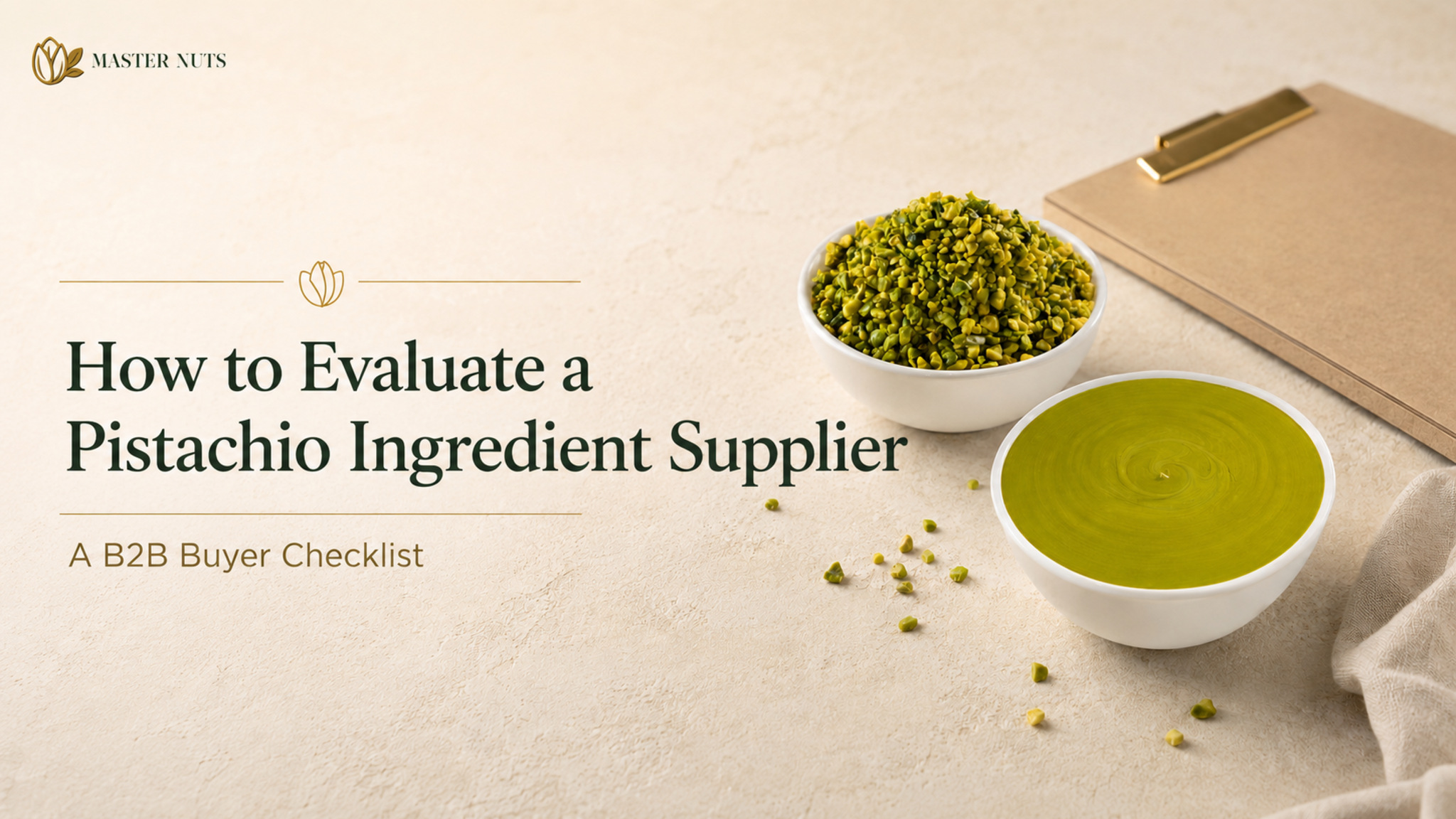
Two suppliers can offer a product with a similar name and price, yet present very different risks to a food business. The differences may appear in batch consistency, supporting documents, traceability, delivery planning, or the way a quality issue is handled.
A useful evaluation therefore covers the product, the manufacturer behind it, and the company responsible for supply. The depth of review will vary. A large factory may involve purchasing, food safety, R&D, and production, while a smaller bakery or dessert business may assign the same checks to one or two people.
The following framework is designed for bulk buyers of pistachio ingredients. Each business should adapt it to its product, destination market, and approval procedure.
- 1. Identify the supplier, manufacturer, and document owner
- 2. Define the product and its acceptance criteria
- 3. Review safety and compliance documents in the right order
- 4. Check traceability and product identity
- 5. Make sure the sample represents the proposed product
- 6. Assess consistency, supply, and issue handling
- 7. Confirm packaging, shelf life, and delivery planning
- 8. Compare cost in the finished product
- 9. Use one approval checklist
- Five warning signs during evaluation
- Discuss your requirement with Master Nuts
- Frequently asked questions
1. Identify the supplier, manufacturer, and document owner
The company selling the ingredient may be different from the company that manufactures it. This distinction affects which organisation issues the specification, test records, and food-safety documents, as well as who responds when a shipment or quality question arises.
Before reviewing a quotation, establish:
- the legal entity supplying the product
- the manufacturer of the selected product
- the name or code used for the product and grade
- the organisation that issued each certificate or declaration
- the commercial contact responsible for the order
- the route for technical, quality, or shipment questions
Certificates should be reviewed against the manufacturer and product they cover. A logo on a website does not show the document scope, issuing body, or current validity.
For products supplied by Master Nuts, the manufacturer has provided documentation that includes ISO 9001, ISO 22000, HACCP, Halal, and Vegan-related documents. Buyers can request the documents relevant to the selected product and review their scope and validity.
2. Define the product and its acceptance criteria
A supplier cannot recommend a suitable grade from the words “pistachio paste” or “green kernels” alone. The buyer should explain the finished product, how the ingredient will be used, and which attributes matter most.
A concise application brief can cover:
- What is the finished product?
- How will the pistachio ingredient be used?
- Which attributes matter most, such as color, flavor, texture, or visible nut pieces?
- Which process conditions could affect the result?
- What order volume is expected?
- Where is delivery required, and by what date?
- Does the buyer need a document review, a sample request, or a quotation?
The brief does not replace vendor approval. It gives the supplier a clear basis for proposing a product and gives the buyer a basis for judging that proposal.
3. Review safety and compliance documents in the right order
Document review should begin with product identity and the buyer’s mandatory acceptance criteria.
Product specification and COA
The specification defines what the product is expected to meet. A certificate of analysis, or COA, reports selected results for a particular batch.
The specification may address product description, ingredients, physical criteria, chemical and microbiological criteria, allergen information, packaging, storage guidance, and shelf life. The exact content depends on the product and manufacturer.
Complete specifications may contain commercially sensitive details and are often shared directly during supplier evaluation. Master Nuts does not publish its complete confidential specification files on the website.
Where a lot-specific COA is available or required, the buyer should confirm that the product reference, grade, and batch information match the supplied material. Availability and timing should be agreed for the selected product rather than assumed across the full range.
Aflatoxin and other contaminant requirements
Aflatoxin is a specific review point for pistachio ingredients. Applicable limits and sampling requirements can differ by destination, product category, and intended use. A universal limit should therefore not be copied from another market or product.
The buyer’s food-safety team, or the person responsible for approval in a smaller business, should define the applicable requirement before ordering. The supplier can then be asked:
- Which aflatoxin result or document is available for the product or batch?
- Which unit and test reference are used?
- Can the result be connected to the product and lot under review?
- Does the document match the buyer’s destination and product category requirements?
Sampling and testing context matters. A result is easier to assess when the product identity, lot reference, and basis of the test are clear.
Microbiological and allergen review
The buyer should confirm which microbiological parameters are relevant to its product category and destination. The article does not prescribe universal limits because acceptance criteria vary.
For allergen management, useful questions include:
- What allergens are declared for the product?
- Are other nuts or allergens handled at the manufacturing facility?
- What cross-contact information is available?
- Which label statement applies to the supplied product?
- How would a material change in the allergen profile be communicated?
Other supporting documents may include country-of-origin information, a GMO declaration, packaging information, or shelf-life guidance. The required list should come from the buyer’s own approval process.
4. Check traceability and product identity
A grade name, product code, specification revision, and lot number serve different purposes:
- the grade describes a defined commercial or quality category
- the product code identifies the supplied product or SKU
- the specification revision identifies the document version
- the lot number identifies a production batch
These references should point to the same product under review. This helps the buyer compare later deliveries with the approved specification and sample.
Traceability goes further than finding a lot number on the label. Ask what information can connect the supplied lot to manufacturing and quality records, and how a question about a later batch would be investigated. Buyers with formal approval procedures may also ask about the route for nonconforming product, withdrawal, or recall information.
Change notification should remain a question unless a documented process has been reviewed. Ask whether the supplier or manufacturer has a defined method for notifying buyers of material changes in raw-material origin, formulation, processing, packaging, or specification.
5. Make sure the sample represents the proposed product
A sample is useful when its identity and purpose are clear. Record the product name, grade, sample or lot reference when available, receipt condition, and the product offered for regular supply.
It is also worth confirming whether the sample came from a production lot or another type of trial batch. Sample packaging and storage can influence color, aroma, and oxidation, so these details should be recorded when they could affect the decision.
Use a controlled trial method. Keep the main process conditions consistent, define the acceptance criteria before the test, and document any formulation or process adjustments required for each sample.
For example:
- A chocolate manufacturer can evaluate pistachio paste in the intended filling recipe and production process.
- A gelato or ice cream brand can record color, flavor, dispersion, and any relevant texture or separation observations during its normal process and holding period.
- A bakery or pastry manufacturer can assess cut appearance, distribution, and texture in the finished product.
A successful sample trial supports product selection. Future deliveries still need to meet the agreed specification and any required batch checks.
6. Assess consistency, supply, and issue handling
Buyers often need the same product over repeated orders. The evaluation should therefore cover the supplier’s ability to identify the approved product, communicate availability, and respond when a later delivery differs from expectations.
Useful questions include:
- Is the quoted product tied to a defined grade and specification?
- What information is available when a later lot differs in color, flavor, cut, or processing performance?
- How are availability and expected timing confirmed before each order?
- Is there a clear route for reporting a damaged, delayed, or nonconforming delivery?
- Who coordinates the response when technical information is needed?
These questions do not assume that a formal process exists. They help the buyer determine what support is actually available before approval.
7. Confirm packaging, shelf life, and delivery planning
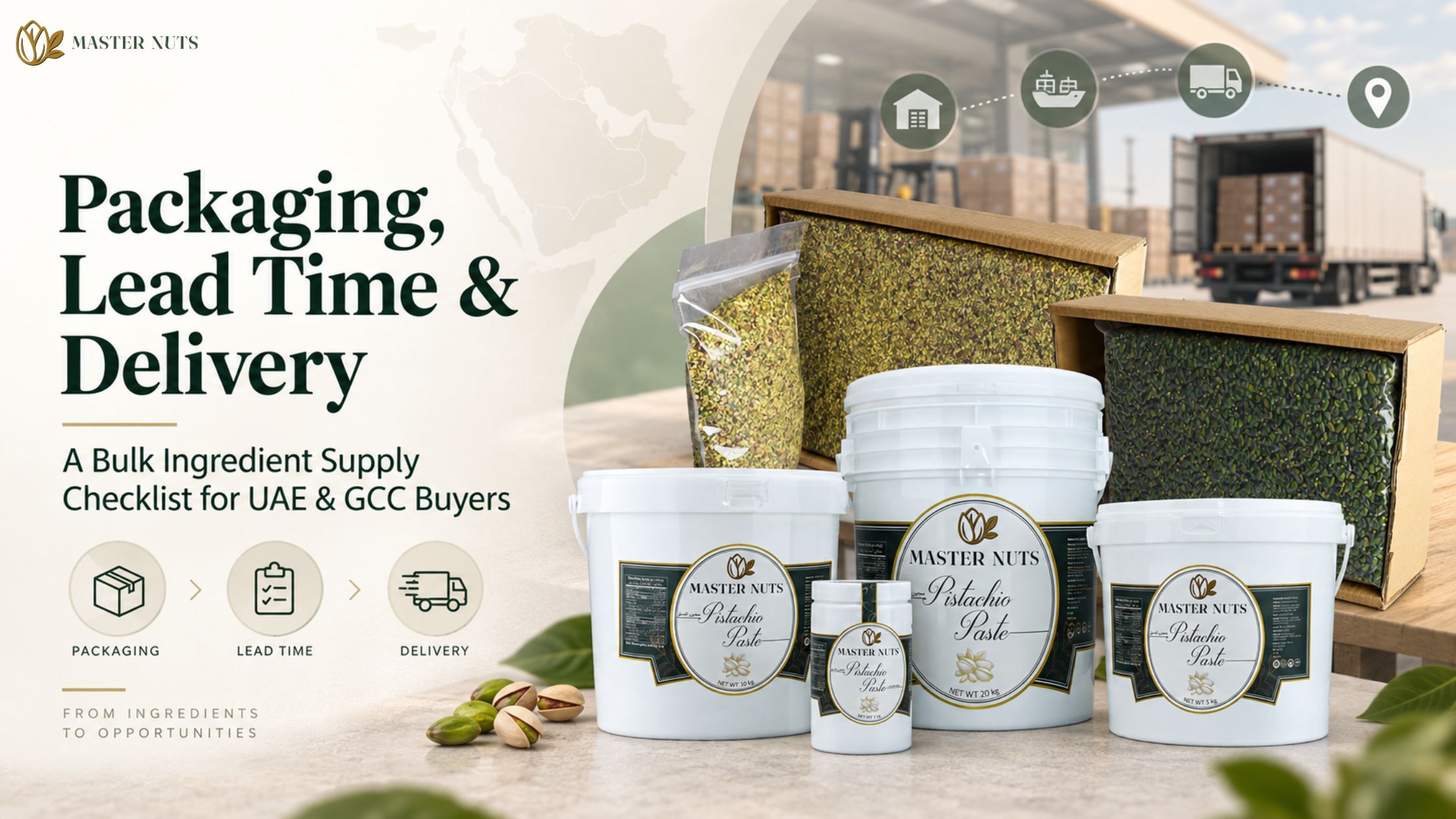
Packaging details can differ by product, grade, and shipment. The quotation or order confirmation should identify the applicable pack format, net weight, label information, lot identification, and any receiving requirements.
Shelf-life review should cover the unopened product, the date from which shelf life is calculated, stated storage conditions, and any guidance after opening. These details should come from the applicable product document. A shelf-life statement for one pistachio format should not be applied to another product without confirmation.
Master Nuts evaluates delivery options case by case and can support a range of regional and international destinations, subject to the product, shipment route, and applicable trade and transport requirements.
The usual delivery estimate is around 20 days after final order confirmation. The sales team confirms the destination, availability, shipment plan, and relevant delivery milestone for each order, so the estimate should not be treated as a fixed promise for every route.
8. Compare cost in the finished product
Price per kilogram is only one input. A buyer can compare cost per finished batch using its own dosage, yield, processing loss, waste, rework, and rejection data.
The comparison may also consider the amount required to reach the target flavor, color, or visual result, along with freight, storage, and the operational cost of inconsistent material. Universal dosage or savings claims are unreliable because formulations and production systems differ.
This calculation should use the buyer’s own trial results and production records. No general percentage can replace that information.
9. Use one approval checklist
The following table separates mandatory checks from business-specific decisions. In a smaller company, the same person may own several rows.
| Review area | Priority | Evidence or question | Suggested owner | Status |
|---|---|---|---|---|
| Product identity | Mandatory | Are the product, grade, product code, and specification revision clear? | Purchasing / Technical | ☐ Pass ☐ Open |
| Specification | Mandatory | Has the applicable confidential specification been reviewed? | QC / Food Safety | ☐ Pass ☐ Open |
| Aflatoxin and contaminants | Mandatory | Are the required criteria and relevant batch documents defined for the destination and use? | Food Safety | ☐ Pass ☐ Open |
| Microbiological and allergen review | Mandatory | Do the available documents meet the buyer’s approval requirements? | QC / Food Safety | ☐ Pass ☐ Open |
| Manufacturer documents | Mandatory when required | Do the certificate scope and validity apply to the selected manufacturer and product? | QC / Purchasing | ☐ Pass ☐ Open |
| Traceability | Mandatory | Can the supplied lot be connected to product and quality records? | QC / Purchasing | ☐ Pass ☐ Open |
| Sample trial | Business-specific | Was the correct product tested against recorded acceptance criteria? | R&D / Production | ☐ Pass ☐ Open |
| Repeat supply | Business-specific | How are product availability, later-lot questions, and material changes handled? | Purchasing / Operations | ☐ Pass ☐ Open |
| Packaging and shelf life | Mandatory | Are pack, label, storage, and shelf-life details confirmed for the selected product? | Operations / QC | ☐ Pass ☐ Open |
| Delivery planning | Mandatory | Are destination, timing, shipment plan, and receiving requirements confirmed? | Purchasing / Operations | ☐ Pass ☐ Open |
| Issue reporting | Mandatory | Is there a clear commercial route for technical, quality, or delivery issues? | Purchasing | ☐ Pass ☐ Open |
A high overall score should never override an open mandatory food-safety requirement.
Five warning signs during evaluation
- The sample cannot be connected to the product offered for regular supply.
- The grade name is used without a specification or clear product identity.
- A certificate is presented without enough information to check scope or validity.
- A batch document cannot be connected to the supplied lot.
- Packaging, delivery, or issue-reporting responsibilities remain unclear before approval.
Discuss your requirement with Master Nuts
For a relevant response, share your company name, product application, preferred pistachio format or grade if known, expected volume, destination, and required delivery date.
Useful starting points include pistachio paste, green peeled pistachio kernels, and diced pistachios. The wider product range includes powder, slivered pistachios, split kernels, regular kernels, cream, and other formats.
Use the form at the bottom of the relevant product page or contact Master Nuts through WhatsApp. If a sample is needed, include the intended application and trial plan; the sales team will confirm availability for the selected product and grade.
Frequently asked questions
What is the difference between a specification and a COA?
The specification defines the requirements a product is expected to meet. A COA reports selected results for a specific batch. A COA should be reviewed against the applicable specification and matched to the product and lot.
Should a buyer approve a supplier based on one sample?
One sample can show whether a proposed product is suitable for a defined application. Supplier approval may also require document review, traceability, packaging, delivery planning, and agreed checks for later batches.
How should aflatoxin requirements be confirmed?
The buyer should identify the applicable destination and product-category requirements, then confirm which batch document, unit, and test reference will be used. The article does not provide a universal limit because requirements and sampling rules can differ.
Does the same pistachio grade suit every food application?
No single grade should be assumed to suit every product. Color, flavor, texture, visible pieces, processing conditions, and cost targets can lead a buyer to choose different formats or grades for gelato, chocolate, bakery, or dessert production.
What information helps Master Nuts prepare a relevant bulk response?
Provide the company name, business type, product of interest, intended application, expected volume, destination, and required delivery date. State whether the request is for document review, sample availability, or a quotation.



Leave a Reply