
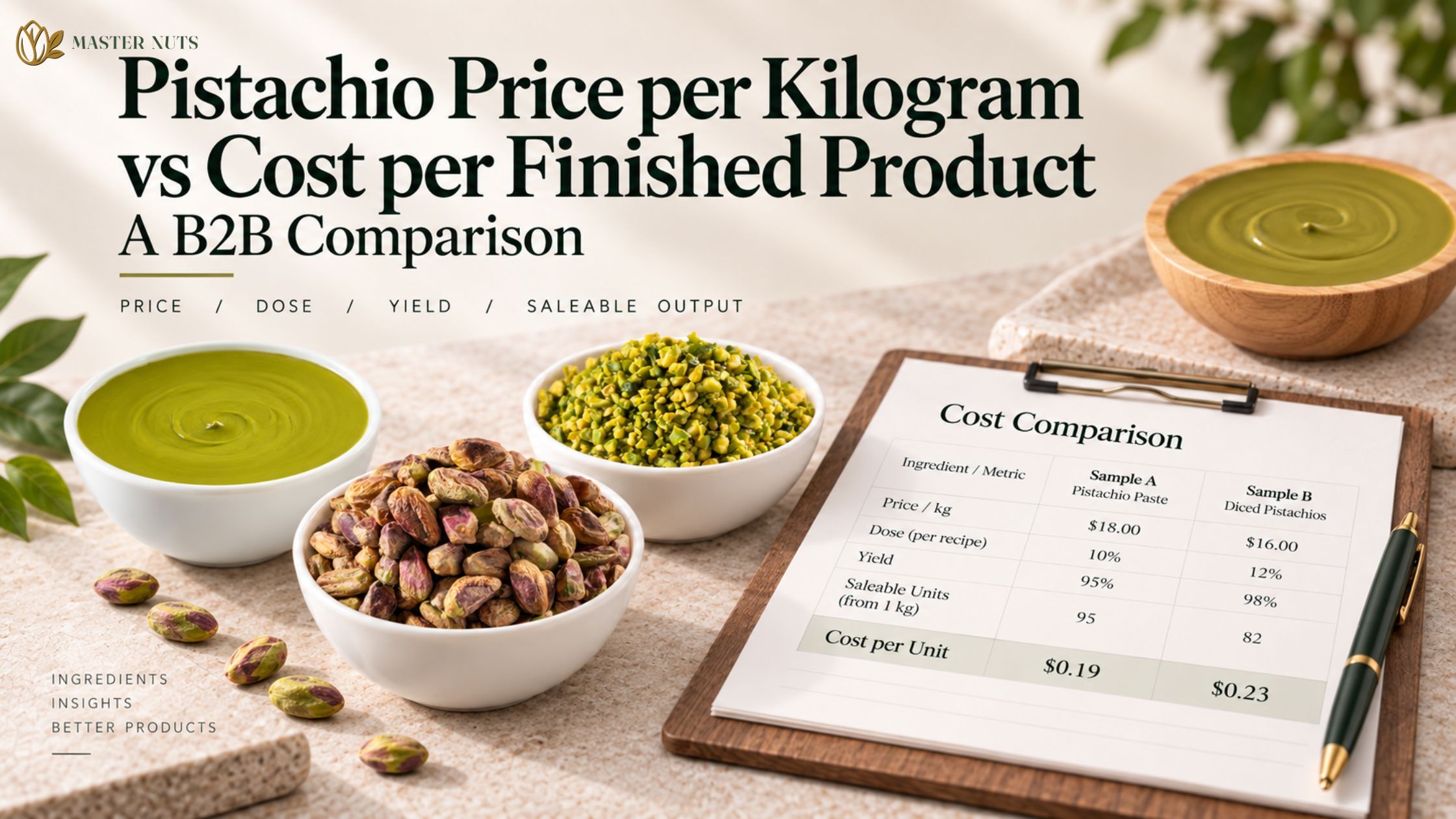
Ingredient quotations make price per kilogram easy to compare. That figure leaves out the amount needed in the recipe, material lost during handling and the number of finished units that pass inspection.
Two pistachio ingredients can therefore change places when the calculation reaches the finished product. A higher-priced paste may work at a lower dose. A consistent diced cut may create the required appearance with less waste. A cheaper option may still win when both samples perform the same.
Buyers need a comparison based on saleable output.
Start with a comparable landed price
Place every quotation on the same commercial basis. Use the same currency and unit, and show which costs are included. Freight, insurance, customs-related charges, local delivery, pallets and temperature controls can change the amount that reaches the factory gate.
Pack size and order volume need context too. A lower unit price at a larger volume helps only when the business can use the stock within its approved storage period. Excess stock ties up cash and increases the chance of write-off.
Keep these commercial fields visible in the comparison:
- Product identity and grade
- Price basis and currency
- Pack size and quantity quoted
- Included delivery costs
- Confirmed lead time
- Shelf life available on delivery
Price per kilogram is the starting input. The production trial supplies the rest.
Calculate ingredient cost per saleable unit
Choose the unit the business sells or measures. It could be a 100 g chocolate bar, a pastry, a jar, a tub or a production kilogram.
Use this calculation:
Ingredient cost per saleable unit = landed price per kilogram × kilograms used in the batch ÷ saleable units produced
The denominator should come from accepted output. Theoretical output hides rejects, process residue and weight variation. Use recent production records for the reference recipe and measured results for each trial.
A batch-level model can add the cost of other ingredients later. Keeping the pistachio line separate at first makes the comparison easy to audit.
Dosage can reverse the price ranking
Compare candidates at the dose that meets the same product brief. One paste may deliver the required pistachio character at a lower use level. Another may need more material or a change elsewhere in the formula.
Set the flavour, colour and texture target before the trial. Keep the base recipe and process comparable, then establish the practical dose for each sample. R&D should approve the complete formula used for costing because a dosage change can affect fat balance, sweetness, solids or fill weight.
The example below is illustrative. It is a calculation model rather than a Master Nuts quotation.
| Trial input | Candidate A | Candidate B |
| Landed price | AED 42.00/kg | AED 48.00/kg |
| Approved use per batch | 6.0 kg | 5.0 kg |
| Pistachio cost per batch | AED 252.00 | AED 240.00 |
| Saleable units | 950 | 980 |
| Pistachio cost per saleable unit | AED 0.265 | AED 0.245 |
Candidate B carries the higher kilogram price in this example and produces the lower ingredient cost per accepted unit. A different recipe or trial result could produce the opposite outcome.
Add usable yield and handling loss
Purchased weight can differ from usable weight. Paste remains on pail walls, transfer tools or equipment. Powder can cling to packs or form lumps. Diced pieces may arrive with fines or break further during transfer.
Measure these losses during a representative trial. Weigh the pack before and after emptying, record material recovered and note any preparation such as stirring or warming. For cuts, compare the issued weight with the amount that reaches accepted units and the visible result the product brief requires.
Packaging can affect yield. A pack that matches normal batch consumption may reduce opened stock and residual material. It still needs to fit warehouse space, manual-handling limits and the production schedule.
Cost the process change
Ingredient choice can alter labour, energy, throughput and cleaning. Record observed differences rather than applying a generic surcharge.
Useful process entries include:
- Preparation time before dosing
- Mixing, refining or conching time
- Pumping, feeding or manual transfer
- Line stops and blockages
- Cleaning time
- Rework, rejects and weight giveaway
- Opened-pack storage and waste
Separate one-time setup from recurring work. A revised instruction may require a single validation exercise. A permanent extra mixing step belongs in the unit-cost model.
Quality risk also has a cost. Use the company’s own history for rejected batches, complaints or emergency purchases. A universal penalty would be guesswork.
Check whether the ingredient changes the formula
An ingredient rarely sits alone in the recipe. A paste may change the amount of another fat. Powder or cut size can affect texture and solids. A stronger flavour result may allow another flavouring to be reduced.
Record every approved formula change and cost the complete difference. Hidden offsets can make one ingredient look cheaper than it is. They can also hide a saving that comes from removing another input.
For visible pistachios, compare the dose needed for an accepted appearance. Equal weight is useful for the first test. The final commercial model should use the amount that meets the approved coverage and bite.
Scale the model with production evidence
Bench trials help screen flavour and formulation. A line trial exposes transfer, dosing, breakage and cleaning issues. Update the model with production data before projecting annual savings.
Label every assumption. If the calculation uses a forecast volume, yield or dose, keep that cell visible. Teams can then replace it when actual data arrives.
Run a sensitivity check around the inputs that move most. A small change in dose or reject rate can matter more than a small change in quoted price. This helps procurement see which supplier difference deserves negotiation and which one requires technical work.
Use one decision table across teams
A compact record can show landed price, approved dose, cost per batch, saleable yield, process changes, packaging fit, lead time and approval status. Procurement brings the commercial terms. R&D owns the formula and product target. Quality identifies the acceptance points that protect the finished food.
The decision can then be stated plainly: which candidate meets the brief at the best measured cost per accepted unit, with a supply arrangement the business can operate?
Master Nuts supplies pistachio paste and other pistachio ingredients for professional production. Share your application, expected usage and destination through the inquiry form or WhatsApp to request suitable samples and a quotation for your own cost trial.




Leave a Reply