
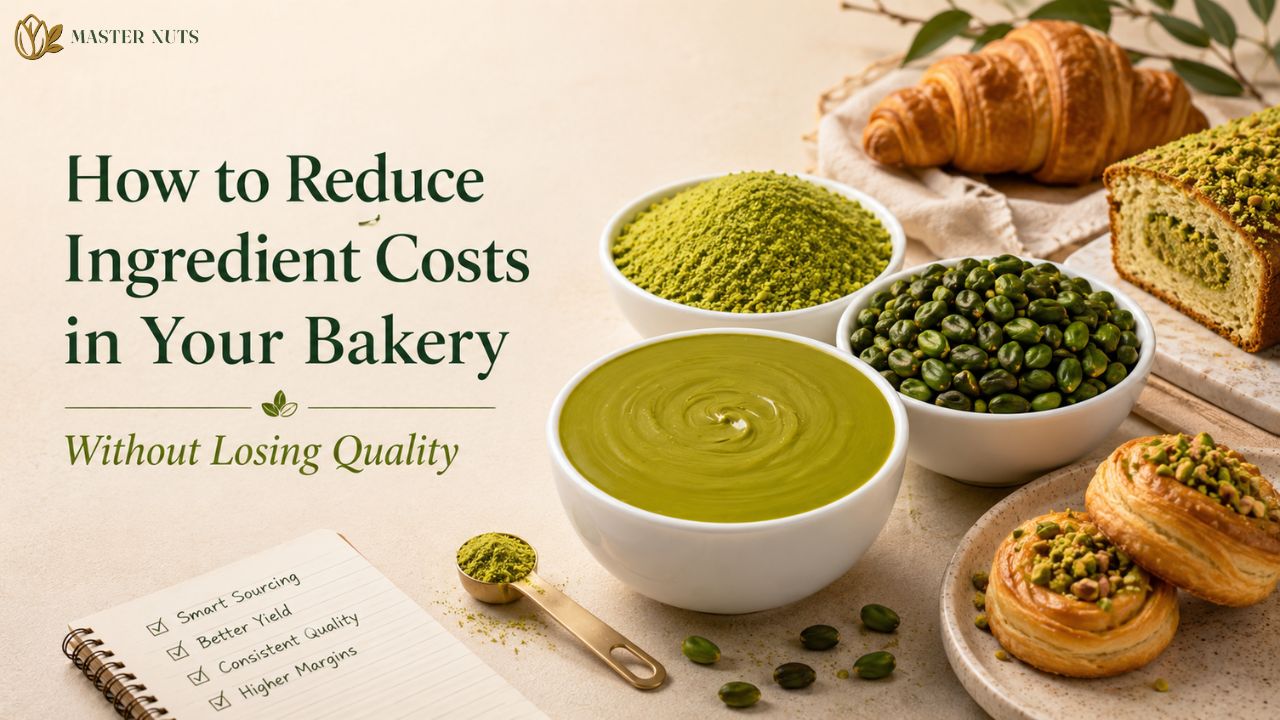
For many bakeries, ingredient costs represent one of the largest operating expenses. Rising raw material prices, supply chain fluctuations, and increasing customer expectations have made cost management more important than ever.
However, reducing ingredient costs does not mean compromising product quality.
In fact, the most successful bakeries focus on improving ingredient efficiency rather than simply purchasing cheaper ingredients.
This is especially true when working with premium ingredients such as pistachios. Whether you’re producing pistachio croissants, cakes, cookies, fillings, or premium desserts, pistachio ingredients are often among the most expensive items in your recipe.
The challenge is finding ways to control costs while maintaining the quality standards your customers expect.
In this guide, we’ll explore practical strategies that bakeries can use to reduce ingredient costs, optimize pistachio usage, and improve profitability without sacrificing product quality.
- Why Ingredient Cost Management Matters
- Understanding Pistachios as a High-Cost Ingredient
- 1. Choose the Right Pistachio Grade for Each Application
- 2. Use Different Pistachio Formats Strategically
- 3. Reduce Waste Through Portion Control
- 4. Build Long-Term Relationships with Suppliers
- 5. Optimize Recipe Formulation
- 6. Focus on Visible Value
- 7. Forecast Demand More Accurately
- 8. Review Product Profitability
- Cost Reduction vs Quality Reduction
- A Practical Example
- Final Thoughts
- Looking for Cost-Effective Pistachio Ingredients?
Why Ingredient Cost Management Matters
Many bakery owners focus primarily on increasing sales.
While revenue growth is important, profitability often depends on controlling costs.
Consider this example:
If a bakery reduces ingredient costs by just 5%, the impact on profit margins can be significant often equivalent to generating thousands of dollars in additional sales.
This is why leading bakery businesses regularly review:
- Ingredient sourcing
- Recipe formulation
- Production efficiency
- Supplier relationships
The goal is not to use cheaper ingredients.
The goal is to achieve the same customer experience more efficiently.
Understanding Pistachios as a High-Cost Ingredient
Pistachios are considered a premium bakery ingredient because they offer:
- Rich flavor
- Natural color
- Premium appearance
- Strong customer appeal
Products featuring pistachios often command higher selling prices.
Examples include:
- Pistachio croissants
- Pistachio-filled donuts
- Pistachio cakes
- Pistachio cookies
- Premium dessert items
However, pistachios also represent one of the highest ingredient costs in many bakery operations.
That makes efficient usage especially important.
1. Choose the Right Pistachio Grade for Each Application
One of the most common mistakes bakeries make is using the highest-grade pistachios for every application.
Not every recipe requires premium-grade ingredients.
Example
A bright green premium pistachio kernel may be ideal for:
- Visible toppings
- Luxury pastries
- Decorative applications
However, the same grade may be unnecessary for:
- Internal fillings
- Baked mixtures
- Processed creams
In many cases, a commercial-grade pistachio can deliver the same flavor performance at a lower cost.
Practical Tip
Match the pistachio grade to the application.
Use premium grades where customers can see them.
Use more economical grades where appearance is less important.
This strategy alone can significantly reduce ingredient costs.
2. Use Different Pistachio Formats Strategically
Many bakeries automatically purchase whole pistachio kernels.
However, different pistachio formats can offer better cost efficiency depending on the application.
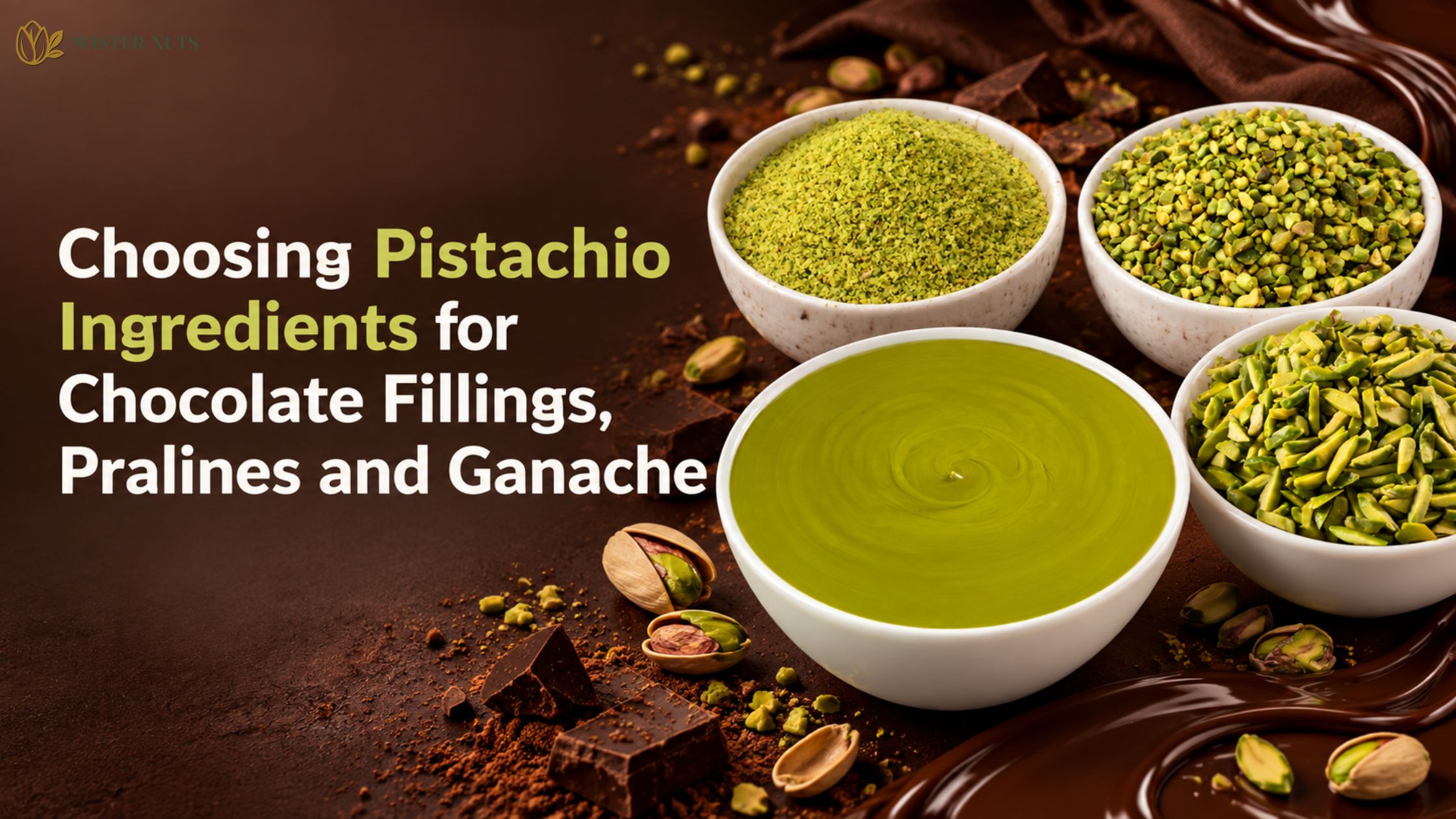
Available options often include:
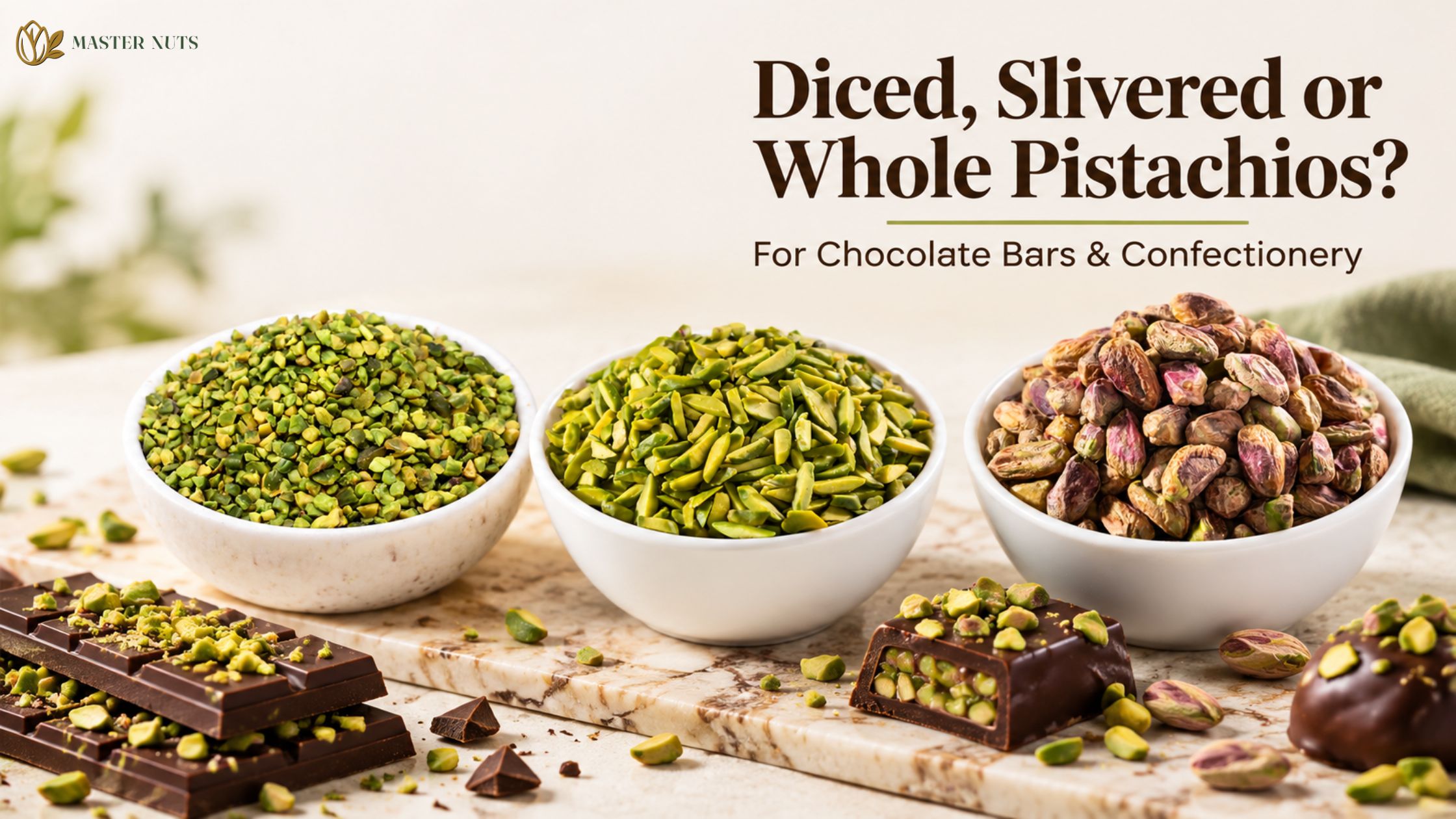
- Pistachio kernels
- Green pistachio kernels
- Pistachio paste
- Pistachio powder
- Diced pistachios
- Slivered pistachios
- Pistachio Split
Each format serves a different purpose.
Example
For cake batter:
Pistachio powder may provide more even flavor distribution than whole kernels.
For toppings:
Diced pistachios may be more cost-effective than manually chopping kernels.
For fillings:
Pistachio paste can provide stronger flavor with less ingredient waste.
Choosing the right format can improve both production efficiency and cost control.
3. Reduce Waste Through Portion Control
Ingredient waste is one of the biggest hidden costs in bakery operations.
Small over-portioning errors can add up quickly.
For example:
If a bakery adds just 2 extra grams of pistachios to 500 products per day, the annual cost impact can be substantial.
Practical Actions
Implement:
- Standardized recipes
- Digital scales
- Portioning guides
- Staff training
The goal is consistency.
Customers should receive the same product every time, while the bakery avoids unnecessary ingredient loss.
4. Build Long-Term Relationships with Suppliers
Many bakeries purchase ingredients based solely on price.
This can be a costly mistake.
Reliable suppliers often provide value beyond the lowest price.
Benefits may include:
- Consistent quality
- Stable pricing
- Better product recommendations
- Improved inventory planning
- Technical support
A strong supplier relationship can help bakeries optimize purchasing decisions and avoid costly quality issues.
Practical Tip
Instead of comparing only price per kilogram, evaluate:
- Product consistency
- Delivery reliability
- Available grades
- Application expertise
These factors often have a greater impact on profitability than small price differences.
5. Optimize Recipe Formulation
Reducing ingredient costs does not always require changing suppliers.
Sometimes small recipe adjustments can improve efficiency.
Example
A bakery may discover that:
- 8% pistachio content delivers nearly the same customer experience as 10%
- A combination of pistachio paste and pistachio powder creates better flavor efficiency
- Different ingredient formats improve flavor distribution
These adjustments can reduce ingredient costs without affecting perceived quality.
Important
Any changes should be tested carefully to ensure customer satisfaction remains unchanged.
6. Focus on Visible Value
Customers judge premium bakery products based largely on what they can see.
This creates opportunities to optimize ingredient usage.
Example
A croissant topped with premium green pistachio pieces creates strong visual impact.
The filling inside may not require the same expensive grade.
This approach allows bakeries to maximize customer perception while controlling ingredient costs.
Think Like a Customer
Ask:
“What part of this product influences purchasing decisions most?”
Allocate premium ingredients to those areas.
7. Forecast Demand More Accurately
Over-ordering ingredients creates:
- Storage costs
- Waste risk
- Cash flow pressure
Under-ordering creates:
- Production interruptions
- Emergency purchases
- Higher costs
Improving demand forecasting helps bakeries purchase ingredients more efficiently.
Track Key Metrics
Monitor:
- Weekly sales trends
- Seasonal demand
- Product popularity
- Promotional activity
Better forecasting often leads to lower ingredient costs over time.
8. Review Product Profitability
Not all pistachio products generate the same return on investment.
Some products consume large amounts of expensive ingredients while generating limited profit.
Practical Exercise
Calculate:
- Ingredient cost per product
- Gross profit per item
- Sales volume
You may discover that some pistachio products are highly profitable while others contribute little to overall business performance.
This information helps guide smarter menu decisions.
Cost Reduction vs Quality Reduction
Many businesses confuse cost reduction with quality reduction.
They are not the same thing.
Poor Strategy
- Buy lower-quality ingredients
- Reduce ingredient levels dramatically
- Compromise customer experience
Smart Strategy
- Optimize sourcing
- Improve portion control
- Select appropriate grades
- Reduce waste
- Improve forecasting
The goal is maintaining customer satisfaction while improving operational efficiency.
A Practical Example
Imagine a bakery selling pistachio croissants.
Instead of using premium pistachios throughout the product, the bakery could:
- Use premium green pistachios for visible toppings
- Use commercial-grade pistachio paste in the filling
- Standardize portion sizes
- Purchase through a reliable ingredient supplier
The result:
✔ Consistent quality
✔ Lower ingredient costs
✔ Strong visual appeal
✔ Better profit margins
This is how many successful bakery businesses manage premium ingredients.
Final Thoughts
Reducing ingredient costs is not about finding the cheapest ingredients available.
It is about making smarter decisions.
For bakeries using premium ingredients such as pistachios, the biggest opportunities often come from:
- Choosing the right grades
- Selecting the right ingredient formats
- Improving portion control
- Reducing waste
- Building supplier relationships
- Optimizing recipes
These strategies help bakeries protect quality while improving profitability.
The businesses that succeed long term are not necessarily those that spend the least on ingredients—but those that use them most efficiently.
Looking for Cost-Effective Pistachio Ingredients?
At Master Nuts, we supply bakeries, pastry shops, and food manufacturers across the UAE and Middle East with a wide range of pistachio ingredients, including Green Pistachio Kernels, Pistachio Paste, Pistachio Powder, Diced Pistachios, and Slivered Pistachios.
Our team can help you choose the right grades and formats for your application, allowing you to balance quality, consistency, and cost.
👉 Request Pricing
👉 Request Samples
👉 Speak with Our Product Specialists
Leave a Reply