
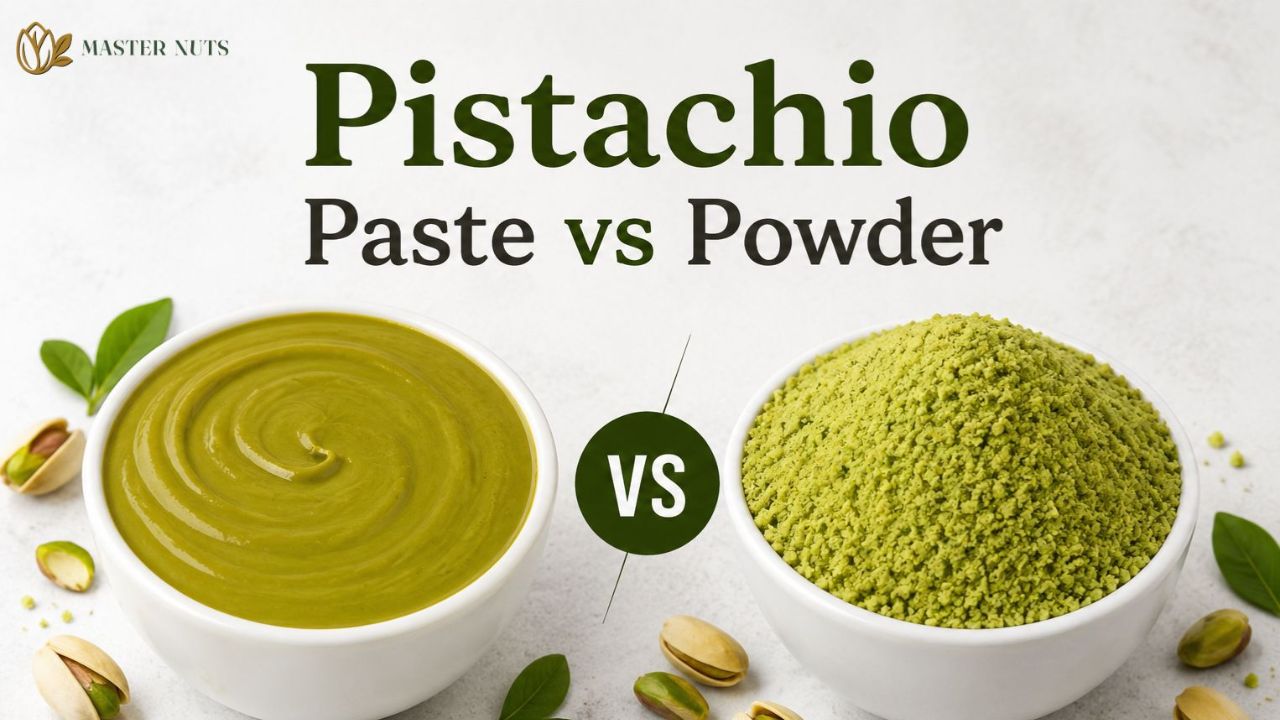
Pistachio paste and pistachio powder can both carry flavor, color and nut solids into a food product. Their physical forms change how a production team weighs, disperses and evaluates them.
Paste has a pasty consistency created by grinding pistachio kernels. Powder is finely ground pistachio material with visible particles and the nut’s natural oil. It remains a full-fat nut ingredient; flour-style assumptions can produce a poor trial.
| Feature | Pistachio paste | Pistachio powder |
| Physical form | Continuous, spoonable mass of ground pistachio kernels | Finely ground, particulate pistachio material |
| Natural oil | Present within the ground nut mass; separation can vary by product | Still present in the ground nut; it should not be treated as a low-fat flour |
| Flavor and color | Depend on raw material, grade, process and use level | Depend on raw material, grind, grade, process and use level |
| Formula effect | Can change dispersion, fat balance and texture in a base or filling | Particle load and grind can change structure, texture and handling |
| Common starting points | Gelato bases, creams, fillings and blended centers | Bakery mixes, coatings, toppings, inclusions and some creams |
| Handling focus | Homogeneity, flow, oil separation and dispersion | Grind, clumping, particle distribution and ease of handling |
| Cost comparison | Compare usable yield and cost per finished unit | Compare usable yield and cost per finished unit |
Neither format is a direct one-for-one substitute. The useful comparison is the result in the finished food under a controlled trial.
Start with the job inside the recipe
The finished product gives the clearest brief. A smooth gelato base, a pastry filling, a cake batter and a chocolate bar ask for different forms of distribution.
Pistachio paste is a practical starting point when the recipe needs a continuous, spoonable ingredient that can be mixed through a base or filling. Pistachio powder begins as a particulate ingredient. It can appear in dough, coatings, decoration, cream or another processed mixture, depending on its grind and the formula.
Those descriptions define format only. Actual performance varies with particle size, natural oil, moisture, surrounding ingredients and the production method.
What the two samples reveal on the bench
Open the candidates under the same conditions and keep each one tied to its product code and lot.
Paste can be checked for color, aroma, homogeneity, flow and any oil separation. Powder needs checks for color, aroma, particle distribution, clumps and ease of handling. A small sieve or particle check may help when grind affects the recipe, provided the team uses the same method for every sample.
Bench inspection tells QC whether the sample matches the agreed reference. R&D still needs to see the ingredient inside the actual food.
Mixing and texture need separate trials
Paste enters the formula as a concentrated mass of ground nut solids and oil. The mixing sequence can affect dispersion. Powder enters as particles and may absorb, carry or release oil differently as the surrounding ingredients hydrate, heat or shear.
Run each candidate in a dedicated batch. Copying the same use level from paste to powder can distort the comparison because the formats occupy different roles. Set the formula for each candidate, record the adjustment and compare the finished products against one brief.
For a bakery trial, watch batter or dough handling, spread, crumb, filling texture and appearance after baking. In creams and fillings, check smoothness, grittiness, flow and holding behavior. The bakery and pastry ingredient guide shows where both formats may enter production, but the recipe trial makes the decision.
Gelato and frozen desserts
Paste is commonly considered when pistachio needs to disperse through a liquid base. The complete frozen test should cover mixing, color, aroma, flavor, texture and the serving-temperature result.
Powder may work as a topping, inclusion or recipe component. Its particle feel becomes more noticeable in some frozen products. Test the chosen grind in the final base and at service temperature. A room-temperature spoon test will miss part of the customer experience.
The detailed pistachio paste guide for gelato gives a broader trial framework for frozen applications.
Chocolate and confectionery
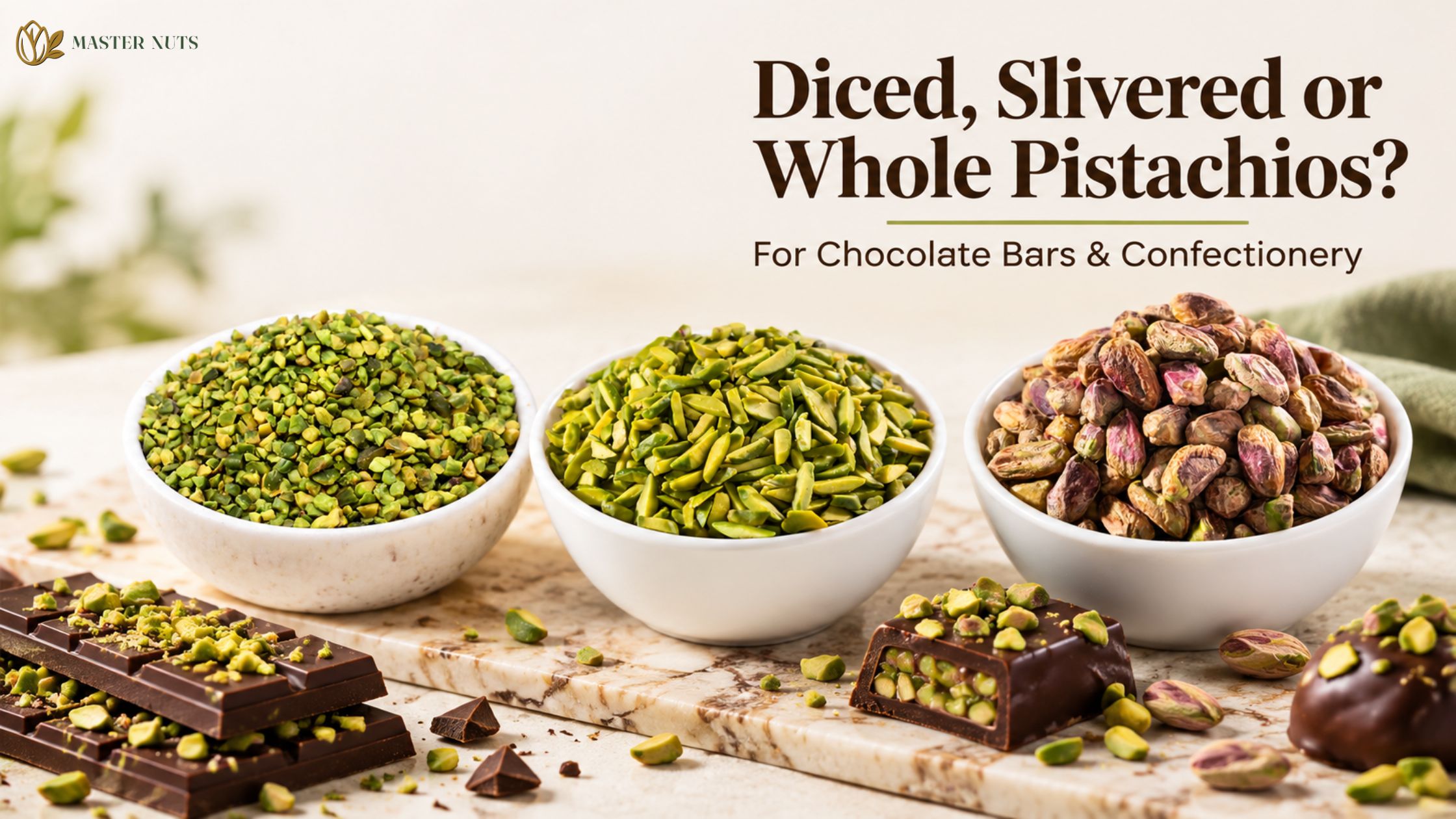
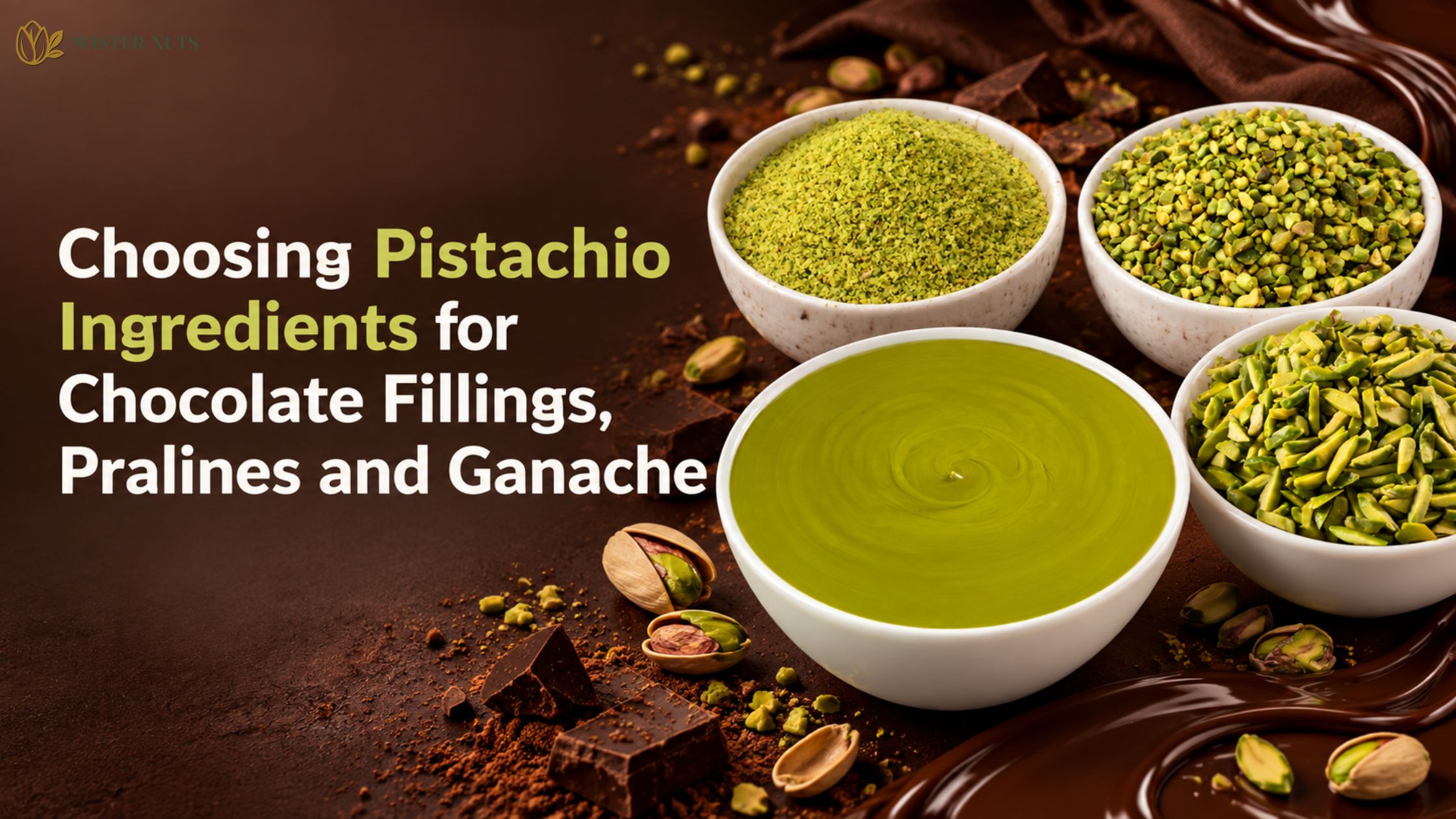
Chocolate, praline, ganache and confectionery systems can use pistachio in several ways. Paste can enter a filling or blended center. Powder can provide visible particles, a coating or a ground component in a separate layer.
Check the ingredient declaration and formulation before substitution. The natural oil and particle load can affect texture, mixing and the fat balance of the complete product. Review the result on production day and after the intended storage period.
A comparison record that production can reuse
Keep the trial record short enough to use on the production floor, but capture four groups of information:
- Identity and documents: supplier, product code, lot, sample date, ingredient declaration and the relevant specification revision.
- Formula and process: use level, mixing order, time, temperature and equipment for each candidate.
- Evaluation: raw appearance and aroma, then finished color, flavor, texture and any process observations.
- Commercial and holding result: usable yield, cost per finished unit, and the result after the planned holding or storage period.
If the team already favors one format, use coded samples for sensory review and reveal the codes only after the observations are locked.
Buying questions differ by format
The questions worth asking are not identical for the two formats:
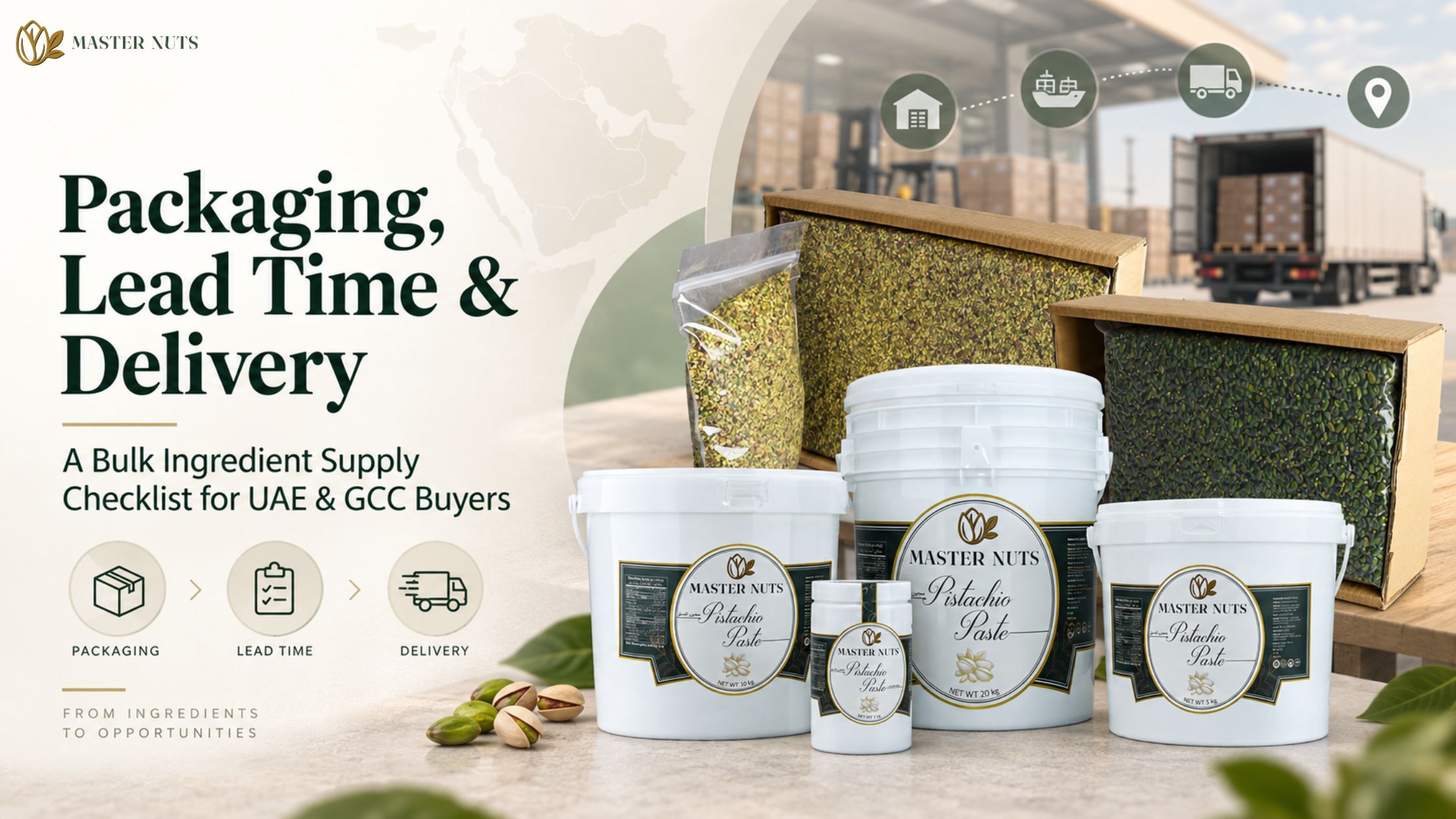
- Paste: product definition, homogeneity checks, packaging suited to the usage rate, and handling guidance after opening.
- Powder: current grind description, the method used to describe particle consistency, packaging barrier and storage guidance.
- Both formats: allergen information, lot traceability and the document set required by the buyer’s quality system.
For moisture, particle size, composition or storage limits, use the controlled product documents rather than the public product name alone.
Choose through the finished food
A powder can suit one component of a product while paste suits another. Pastry businesses may use powder in a sponge and paste in a filling. A confectionery line may use paste in the center and a cut or powder on the surface.
Share the intended food, recipe role, process and expected usage with Master Nuts. The team can help arrange suitable paste or powder samples for a controlled comparison and discuss the wider pistachio ingredient range.
Leave a Reply