
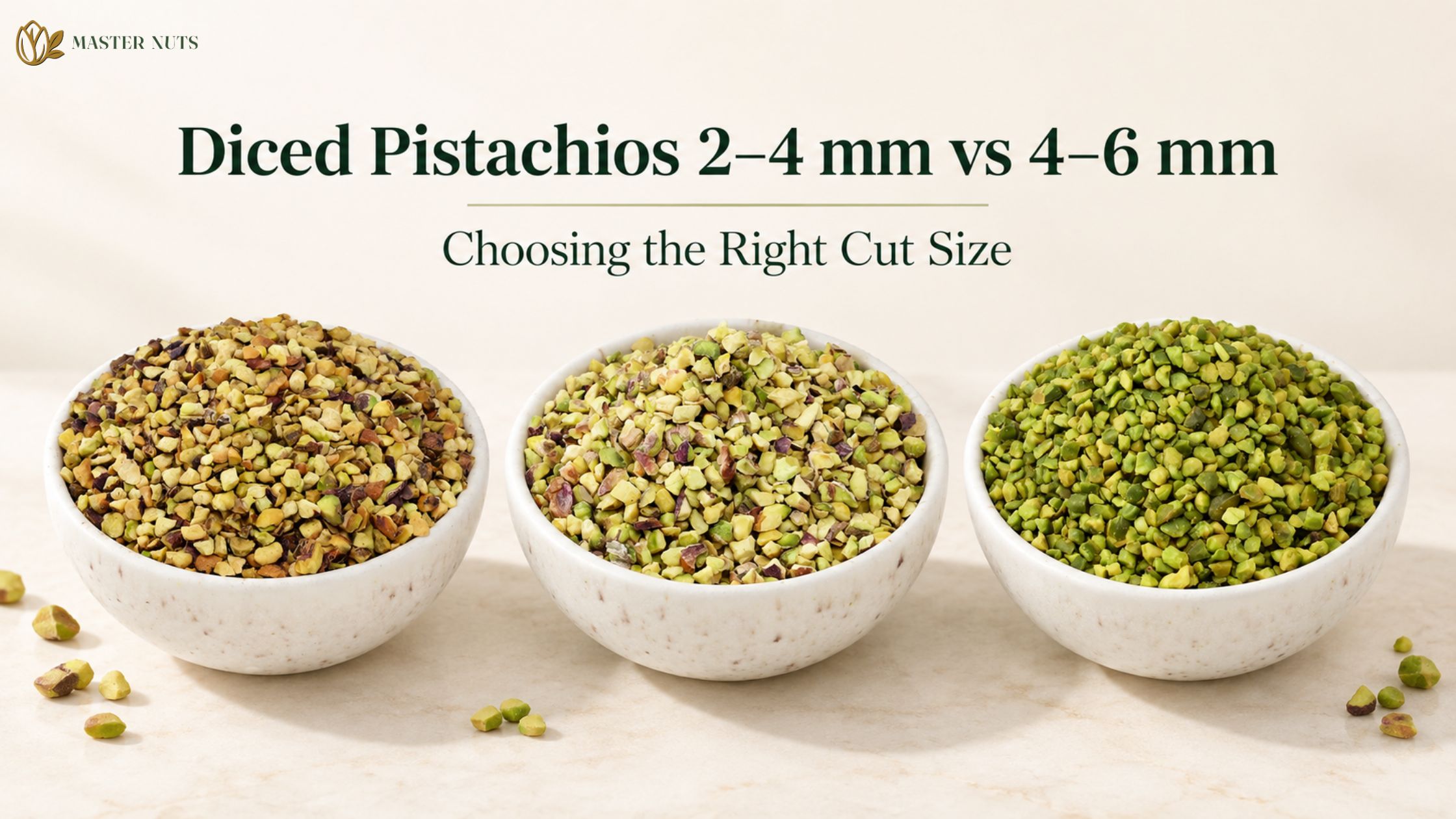
For a thin chocolate bar or a small filled pastry, a few millimeters can change where pistachio pieces sit and how noticeable they feel. A larger topping may suit the design on a cake but crowd a shallow filling. Cut size belongs in the product brief before you request samples.
Start with 2–4 mm when you want smaller pieces distributed through modest portions or a finer topping pattern. Start with 4–6 mm when the brief calls for more visible individual pieces and the food has room for them. Treat those choices as starting points for a trial.
Read the size range as a purchasing description
Diced pistachios are irregular pieces sorted into a stated range. A 2–4 mm label describes a smaller cut than 4–6 mm, but it doesn’t mean every piece is a cube with identical dimensions.
Ask how the supplier measures or screens the range, and what limits apply to fines and oversized pieces. The largest dimension can matter to a depositor even when a piece passes through a sieve in another orientation.
Master Nuts lists both 2–4 mm and 4–6 mm green peeled options on its diced pistachio page. Request the specification and a representative sample for the exact quoted option, including the size distribution your equipment needs.
Keep the kernel type and treatment comparable when testing size. A comparison between smaller green peeled pieces and larger skin-on pieces changes appearance as well as dimensions. That makes it harder to identify which difference caused the result.
Match the cut to the portion
At the same weight, smaller pieces generally mean more individual pieces, assuming similar density and shape. That gives a useful starting hypothesis for distributing pistachio through small portions. Actual distribution still depends on mixing and portioning.
Larger pieces make individual inclusions easier to see. Each piece also occupies more space, which matters when the food is thin or the filling layer is shallow.
| Product brief | First cut to trial | What to inspect |
|---|---|---|
| Small portions with scattered inclusions | 2–4 mm | Portion-to-portion distribution and noticeable nut texture |
| Fine topping pattern on a pastry | 2–4 mm | Gaps, loose material and the amount needed for the design |
| Clearly visible pieces on a cake or dessert | 4–6 mm | Appearance, attachment and bite at serving |
| Chunkier inclusions in a thick cluster | 4–6 mm | Internal fit, piece distribution and eating comfort |
Both cuts remain candidates if the first trial misses the target. The surrounding food and your handling method can change the result.
Give chocolate and fillings a clearance check
For chocolate and confectionery production, compare the pieces with the mold depth and the space available in a shell or layer. Inspect the cross-section after setting. Look for protruding pieces, uneven surfaces and areas where the nut crowds the intended chocolate structure.
A filling also needs to pass through the actual depositor, pipework or nozzle. Use the equipment manufacturer’s guidance for particulates and test a representative sample under normal conditions. A nominal cut range alone cannot guarantee passage through an opening.
Record interruptions, product left in the system and any adjustment to the process. A cut that works in a hand-filled sample can still need changes before it runs reliably on the line.
If the recipe requires a smooth filling, visible diced pieces will change that texture. Settle the intended mouthfeel before choosing a size; the pistachio ingredient guide covers the other available formats.
Compare coverage and bite separately
For a topping trial, use the same food surface and application area. Apply equal weighed amounts of each cut and compare the pattern. Then find the amount of each that meets the chosen appearance.
A smaller cut can produce more scattered points. Larger pieces create a more obvious individual shape. Coverage also depends on how pieces lie, overlap and adhere, so counting visible pieces and measuring covered area answer different questions.
Taste at the intended serving temperature. Assess whether individual pieces feel too large for a spoonful or too subtle to meet the texture brief. Check the result again after the normal holding period, especially when the nut contacts syrup, cream or a moist filling.
Keep the flavor comparison tied to the actual samples. Increasing cut size doesn’t establish a stronger pistachio flavor, and a larger piece isn’t a promise of lasting crunch.
Watch the cut change during production
Take a sample from the incoming bag and compare it with material after the normal transfers and mixing. Record fines already present and any extra fragments created by handling. A stated range is useful only if the material reaching the food still fits the intended job.
Check several finished portions across the trial. Differences between early and late portions can reveal uneven distribution or changes as equipment empties. Use the usual operators and refill method so the observation reflects ordinary production.
Procurement can then compare the amount issued, losses and accepted output for each candidate. Keep labor or downtime visible in the cost record. An attractive price per kilogram gives only part of the cost when a cut requires extra sorting or creates rejected units.
Order against the result you approved
Keep a short approval record with the product code, kernel type, cut range and agreed size tolerances. Add the recipe use level, key process conditions and a photograph of the accepted finished product. Receiving checks can then use the same criteria for later deliveries.
Send Master Nuts the product you make, its portion size or layer depth, and whether pistachios pass through dosing equipment. Include expected usage and destination when requesting samples through the diced product-page form or WhatsApp. If the shape itself is still undecided, compare the options in the diced versus slivered guide.




Leave a Reply